
ZEST 100-Series Manual
Intro
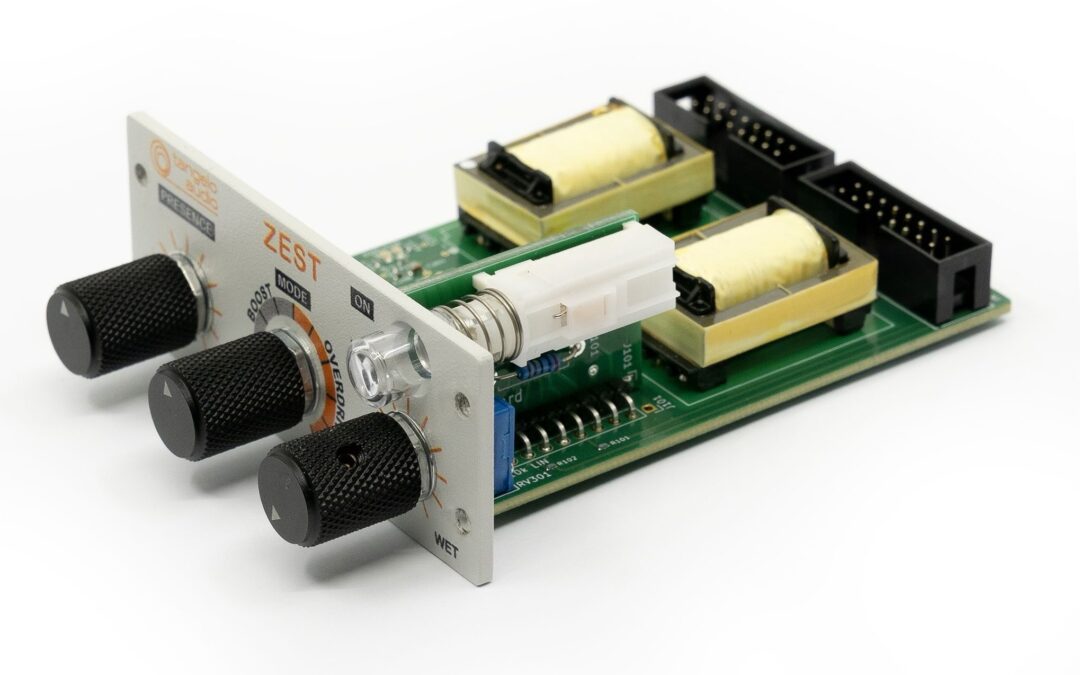
The ZEST module is a presence effect. It cannot be used standalone, but is used within 100 series racks and enclosures.
The ZEST circuit is an all-analogue design based on a transformer saturation effect with a twist.
What’s in the box
- 100 series ZEST module in anti-static packaging
- 5″ 16-pin IDC connector cable
- 4 x M3 cheese head screws
- A QR code to this online manual
Circuit Technicals
A typical transformer in saturation exhibits some even-order harmonic distortion, particularly noticeable on the bass end of the frequency spectrum, which results in a pleasant mellow effect.
The transformers in ZEST are driven a little differently, and the circuit exhibits both even and odd harmonic distortion throughout the frequency spectrum (odd being more prominent), particularly noticeable in the treble end of the spectrum, which creates a “presence” effect where the listener feels more engaged with the music.
How to Use it
This module will be installed into a 100-series compatible host, such as a modular mixer or desktop enclosure. Follow the host instructions for installation. You will use the included 16-pin IDC cables to create a “loop” through all your connected equipment. There are notches on the cable plugs and sockets to ensure proper orientation. A good check to remember is that the red wire on one end of the cable denotes pin 1. Pin 1 is typically also denoted on the silkscreen of the PCB with a circular blob next to that pin. When fitted, ensure that no part of the module PCB is touching any bare metal or loose cables. Any electrical short could damage your equipment.
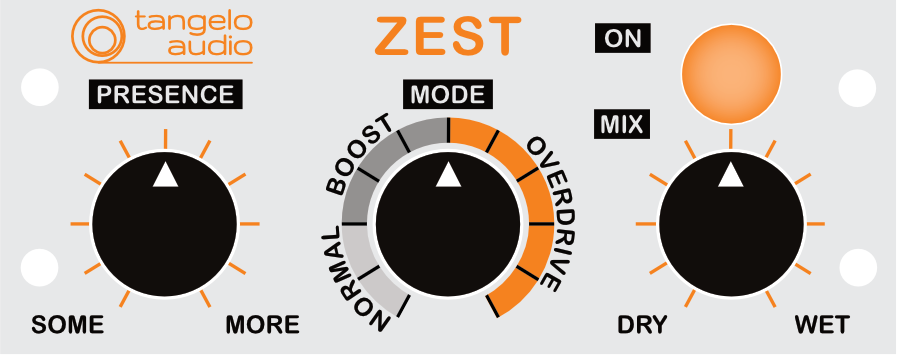
The Pushbutton on the top-right, labelled ON, is the ON/OFF button. This toggles between the effect being engaged or bypassed. When the button is lit, this indicates the effect is active; when unlit, the effect is bypassed. It is a true bypass and the ZEST circuitry is not involved in the signal path.
The two leftmost knobs are sound design controls and the rightmost knob is a mix amount. When first orienting yourself with ZEST, a recommended strategy would be to crank the third knob clockwise to full WET setting, play with the first two controls to hear what the effect does, then dial back the WET/DRY to a suitable level.
The lines on the knob legends are there so you can recall a previous setting. Since the face of a 100 series is small, values were not added to these lines to prevent a crowded look. You may wish to think of the sound design knobs going from 1 to 11, with 6 being halfway, and the third knob as going from 0% to 100% with 50% being halfway.
The knob labelled PRESENCE controls the intensity of the effect. Fully anti-clockwise, the effect is there, but subtle. Turning it clockwise doesn’t create more harmonics, but intensifies the ones created by the circuit. As a guide, with a typical signal of 2.3V RMS, fully turning this knob will increase the harmonic distortion by about 10dB. If you desire even more harmonics, you can run the signal hotter into ZEST.
As you change the PRESENCE control, you will also change phase reinforcement and cancellation of various frequencies, caused by the transformer circuit, and you should hear certain sounds pop out more. This is particularly useful if sounds are getting lost in a mix and adjusting channel volume is too blunt a tool. For example, for a percussion sound, you may find it starts to “pop” at level 1 or 2, whereas a synth sound may require 5 or 6 to become more focused in the mix. You have to play with it a little to discover what level works for what sound.
The nature of the effect circuitry means that with all the additional harmonics, it can sound bright with certain source material. That is where the MODE control comes in. The effect output can be fine-tuned with this knob. In the normal zone, the brighter transformer output will be blended with an appropriate amount of low-end to create a balanced sound. When you head into the boost section, the transformer circuit is stronger by a dB or so and the low-end correspondingly weaker. The sound is not as balanced: in terms of frequency response, its titlted up slightly from about 3kHz and tilted down slightly below it. If you’re using this effect to gain presence, this zone might be exactly what you want.
When the MODE is in the overdrive zone, the frequency response tilts up from 3kHz upwards steeper than that of the boost zone, and frequencies from about 1kHz to 3kHz are dragged up too. So you get the same level of lows in overdrive mode, but mids and highs have been enhanced, leading to a perceived volume increase – hence the term overdrive.
The WET/DRY is a mix control that changes the amount of the effect that you hear from the ZEST module. For example, at 50%, the effect is mixed in equal parts with the DRY (bypassed) signal. You decide how much of the effect you want to shine through. For some instruments or source material, only a whisker will be required, and you may set it at 10%, but othertimes, you may want to crank ZEST to 100% to really hear it perform its magic.
NB: Another way to view these controls, which might fit better in guitar pedal parlance, would be INTENSITY, TONE, and AMOUNT.
Technical Specifications
- 6HP module height
- 2mm aluminium front panel, powder-coated in marine grey
- black-anodized aluminum knurled knobs
- Input impedance: 100k ohms
- Output impedance: 100ohms
- THD (at 1kHz): -108dB
- Dynamic Range: 117dB Noise Floor (100 Hz–20 kHz): –96.7 dBu RMS
This unit conforms to RoHS requirements. Please dispose of it at a recycling facility capable of processing electronics and PCBs.
The packaging has been marked in accordance with Triman requirements. The packaging consists of cardboard and polypropylene, both of which are widely accepted for recycling.
This unit has been tested and conforms to FCC regulations.